You’ve rewritten your research question five times. The question isn’t the problem.
The problem is that your question, your theory and your method don’t line up — and nobody ever showed you how to make them.
For Master’s and PhD students in the social sciences, education, business and communication.
Does this sound familiar?
You pick a topic you care about. You write a research question. Your supervisor says it’s “too broad”. You narrow it. Now it’s “not researchable”. You add a theory because the template says you need one. Then someone asks: “How does this theory shape your interview questions?” — and you realise it doesn’t.
So you start again.
One research methods instructor we interviewed told us her Master’s students spend 4–5 weeks and up to 8–9 rewrites just to define what they’re researching. Not collecting data. Not writing. Just figuring out what the study is.
If you’re stuck in that loop, it’s not because you’re a weak student. It’s because nobody teaches the part that matters most.
Four terms. Ten different definitions online.
Your template asks for a theoretical framework. A YouTube video talks about a conceptual framework. Your supervisor mentions an analytical framework. And half of what you’ve written so far is actually a literature review.
Here’s the short version nobody gives you:
- Literature review — what other studies found. It shows the gap.
- Theoretical framework — an existing theory you borrow as a lens. It tells you what to look at.
- Conceptual framework — your own map of how the key concepts in your study connect.
- Analytical framework — how you will turn your data into findings.
Knowing the definitions is the easy part. Making all four point in the same direction is where proposals fall apart.
It’s not your writing. It’s the chain.
Every solid study is a chain:
question → theoretical lens → concepts → method → the questions you ask → how you analyse the answers.
Each link has to follow from the one before. When one link is off, everything after it is off too — and each part can still look fine on its own. That’s why the feedback feels vague: “it doesn’t hang together”, “where does the theory come in?”, “why interviews?”.
Check if my chain holds — freeYou’ve probably tried these already.
- Your supervisor — knows exactly what’s wrong, but has many students and very little time for each of them.
- YouTube and blogs — explain each term on its own. None of them look at your topic.
- ChatGPT — writes confident paragraphs that sound right and don’t connect. And many universities now flag AI-written text.
What’s missing is someone who walks through your study, link by link, and makes you explain each choice.
The chain doesn’t break at the proposal. It breaks later.
A loose chain survives the proposal stage more often than you’d think. It breaks when you sit down with 15 interview transcripts and realise your questions didn’t ask about the things your theory says matter. Or at your defence, when someone asks “why this theory and not another?”
At that point, fixing it means redoing data collection. Fixing it now is a matter of hours.
Methea walks you through the chain, one link at a time.
It’s a research-methods navigator. You bring your topic; Methea asks the questions a good supervisor would ask, and won’t let you move on until each link holds.
- 1Describe your topic. A sentence or two, or upload your assignment brief.
- 2Sharpen your question. A few focused questions narrow it until it’s researchable.
- 3Choose your lens. Methea suggests theories from a curated library and explains why each fits — you decide.
- 4Get the chain. A framework diagram, a methodology with the reason behind every choice, and an interview guide where every question maps to a concept in your framework.
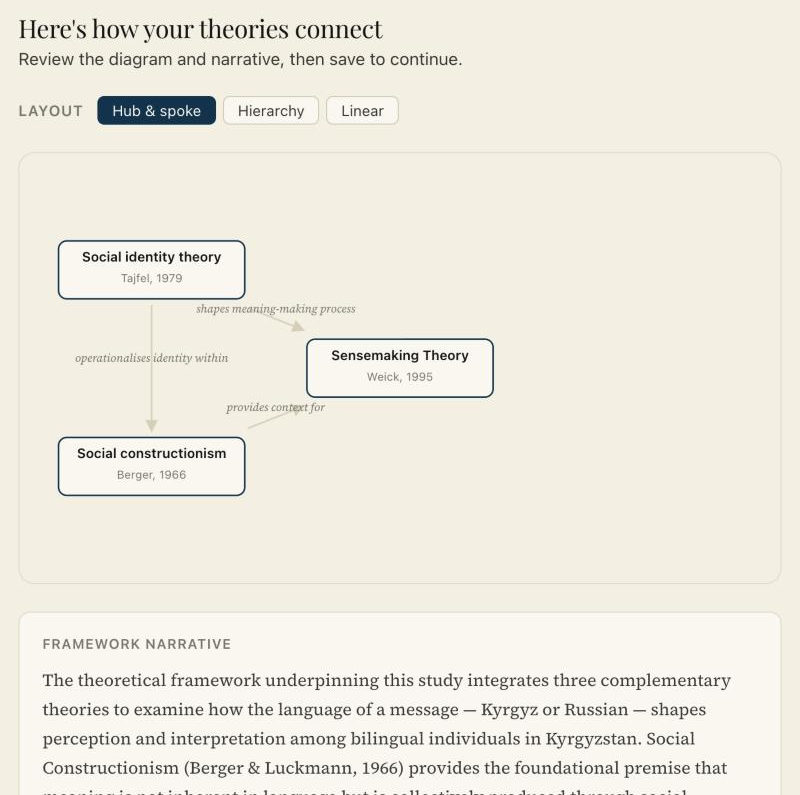
It asks. You decide. You write.
Methea never writes text you’d submit — no essay paragraphs, no discussion, no conclusion. What you get is the structure behind your thinking and the reason for every step. Safe to show your supervisor. Built to help you defend your study, not to write it for you.
Start free. Pay only when it’s working for you.
Free: describe your topic, sharpen your question, get theory suggestions and your framework diagram.
$49 per project, one-time: full framework with verified citations, methodology chain, interview guide, transcript analysis, full export. 6 months of access. No subscription.
14-day money-back guarantee. If it doesn’t help, email us and you get your money back.
Prefer monthly? $15/month — coming soon.
For departments and research groups —
Questions
Is this AI writing my proposal?
No. Methea asks you questions, suggests theories from a curated library with checked citations, and lays out how your framework leads to your methods. You decide, and you write every sentence you submit. It never writes your discussion, conclusion or final report.
Will my university allow it?
Policies differ, so check yours. Methea doesn’t produce text you hand in — it works like a structured planning tool, and you can show your supervisor exactly what it did and why.
What if my field isn’t covered?
Methea is built for the social sciences, education, business and communication, mostly qualitative and mixed-methods research. If the theory you need isn’t in the library, you can add your own and Methea checks its citation where it can. If your project is mainly quantitative or outside these fields, it may not fit well yet.
What do I get for free?
Brief upload, research-question refinement, theory suggestions and your framework diagram, with a watermarked export. No card needed.
Refunds?
14-day money-back guarantee: within 14 days of your purchase you can get a full refund, no questions asked, even if you’ve already used the paid features. Terms